
A label changes with its responsibilities
When Talheim Records emerged in 2008, founder Mathias Rumbold was 17 years old and still at school. Part 2 of this series describes how contacts in the black metal scene, limited means and the first independently organised productions became a label. The more consequential transition came afterwards: every additional release created responsibilities that could not permanently be handled like a single underground project.
During the early years, communication, production preparation, financing and distribution largely converged in one place. Decisions could be made directly, routes were short and problems were often addressed as soon as they appeared. That approach suited a small number of projects. As the catalogue, artist roster and network of manufacturers grew, however, the change was not merely quantitative. Decisions had longer consequences, financial commitments overlapped, and information needed to remain traceable months later.
Talheim Records therefore did not change through one master plan or a sudden leap into complete professionalism. Improvised solutions gradually became repeatable processes. Tasks originally taken on through personal initiative developed into permanent operational responsibilities. This is why the label is organised differently today than it was during its first years.
2013: An initiative becomes a company
On 1 May 2013, Talheim Records e.U. formally began operating as a company. The step gave the existing label work a legal and commercial framework, but it did not mean that every process was complete from that day onwards. Accounting, calculation, contracts, communication with manufacturers and documentation all had to evolve while releases continued.
The financial scale made the significance of this change particularly visible. In some cases, agreements at the time included EUR 1,200 in studio support. Expenditure on physical formats and merchandise followed in addition. These amounts tied up a substantial share of the resources available for production and had to be coordinated with other ongoing and planned commitments. The figures do not describe a general contractual model or every release.
A commitment therefore affected more than the next production step. It influenced which additional projects were possible, when invoices could be paid and what reserves were available for deviations. Basic cost lists developed into more precise calculations. Quotations needed to be comparable, services and rights had to be defined in writing, and payment flows had to be documented properly.
The company registration was consequently not the conclusion of professionalisation, but the beginning of a longer organisational learning phase. Talheim Records had to preserve the direct working style of its early years while creating structures that remained dependable under greater obligations.
More than releases
Early activities also included jointly organised concerts. According to the founder’s recollection, an early format under the name “United We Stand” emerged at Explosiv in Graz around 2013 and 2014, initially resembling a collaborative concert more than a large festival. The precise date of this early edition cannot be established unequivocally from the material currently available.
A later edition is documented more clearly: a three-day “United We Stand” took place at Explosiv Graz from 5 to 7 January 2017. The idea of shared concert evenings had consequently developed into a more extensive event format. This also reflected the label’s transition: collaboration no longer meant releasing a recording alone, but increasingly included creating shared spaces and occasions.
Talheim Records Germany, or TRG, followed a comparable path. Its initial purpose was primarily distribution. Shared channels were intended to make orders and the movement of goods more economical and to reduce costs. At that stage, TRG was neither conceived as a complete copy of Talheim Records nor founded from the outset as a separate development label.
Only later did the idea emerge to develop the practical distribution structure into a sublabel. Not every release needed to appear within the same framework. New artists could receive additional opportunities, gain experience and use a platform whose financial and organisational resources were deliberately more limited than those of Talheim Records. Different release structures could also provide additional reasons to buy directly from the labels.
This development was not linear. Personal plans for the future changed, existing forms of cooperation had to be reconsidered, and other suitable participants had to be sought. Without retrospectively judging individuals or motives, TRG therefore represents a recurring pattern in the label’s history: a practical solution can develop into its own organisational concept, but it must change when the people and conditions behind it change.
Two labels, two identities
As their responsibilities diverged, Talheim Records and TRG also developed visual identities that were related yet distinct. The Talheim Records emblem depicts a golden eagle, two swords and a shield.
The design was intended to express convictions that had accompanied Talheim Records from the outset. The golden eagle represented strength and independence. The two swords symbolised the rejection of left-wing and right-wing extremist ideologies and their divisive effect on people and the music scene. The shield completed the heraldic design.
The Talheim Records Germany emblem instead shows an owl on a branch, also set before a shield. The owl was intended to embody wisdom and calm. The two emblems clearly belong to the same visual family, but they convey different identities. In this respect they also reflect the different functions that developed for the two label structures.
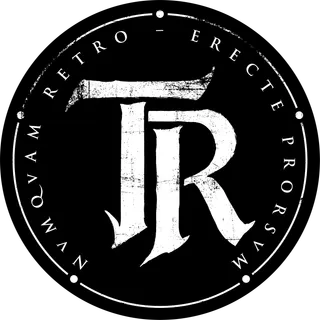
A Latin motto also formed part of the Talheim Records identity. An early version contained linguistic errors and was later changed to the wording “Numquam Retro, Erecte Prorsum”. The correction itself belongs to the history of the label: names, symbols and phrases intended to endure are not exempt from learning and revision.
The emblems should therefore not be read as an immutable endpoint. They document how the label sought to make its position visible at different times. A fuller discussion of the principles that guide Talheim Records today, and how they are applied in practice, belongs to Part 4 of this series.
When improvisation becomes a defined process
For many years, Talheim Records handled a large share of production preparation itself. This included artwork preparation, print files, coordination with manufacturers, the organisation of physical formats and merchandise, and later websites and webshops. Part 2 explains in greater detail how the necessary skills were acquired through practical work. What mattered for the label’s subsequent development was that occasional assistance became a recurring field of work.
Submitted artwork was not always ready for professional manufacturing. Designs regarded as finished sometimes needed technical correction, reconstruction from source material, or adaptation to bleed, resolution and specific production templates. Every intervention took time, affected deadlines and required further questions. Once several projects were running in parallel, experience and memory alone were no longer sufficient.
Checklists, clearer handovers and traceable file versions therefore became more important. Manufacturers needed unequivocal approvals, artists needed to see which material was still missing, and the label required a dependable overview of costs and production status. Care shifted from completing individual tasks to designing the process as a whole.
Doing the work internally had provided flexibility and cost control during the early years. As the number of projects increased, it also revealed its limitations. A label does not become more resilient when every detail depends on one person’s knowledge and available time. Documenting work so that it can be reviewed, transferred or completed jointly consequently became part of production itself.
Collaboration needs traceable structures
Early communication took place primarily and personally through social networks. Questions could be answered quickly and decisions made without formal detours. With only a few simultaneous projects, that proximity was an advantage. As the number of artists and open tasks grew, however, it could create an expectation that the same immediate availability would always continue.
Information was also distributed across individual messages, platforms and informal conversations. Decisions became difficult to locate later, context was lost and responsibilities were sometimes unclear. Personal communication itself was not the problem. What was missing was a dependable framework in which outcomes, tasks and next steps would remain available.
Talheim Records did not respond by moving everything back to conventional email. Communication channels, documentation and responsibilities were structured gradually instead. Personal exchange remained possible, but it was supported by systems in which requests arrive, decisions remain traceable and tasks can be assigned to a responsible role.
Contracts changed at the same time. Early agreements were comparatively simple and focused mainly on the beginning of a collaboration. As investments in artwork, design, studio work, manufacturing and other services increased, that perspective was no longer sufficient. Services, costs, rights and time commitments needed to be described in a way that made their consequences understandable to both sides.
Current agreements can extend to approximately 50 pages including addenda, a glossary and example calculations. They address matters including calculation methods, costs and investment, break-even considerations, minimum commitments, usage rights, potential reversions of rights and the end of a collaboration. Length alone makes no agreement fair or legally unassailable. What matters is whether it answers foreseeable questions before they become a dispute.
The handshake ethos often valued in music scenes is not the opposite of written clarity. Trust makes collaboration possible; dependable agreements help protect that trust when expectations, schedules or economic circumstances change. An orderly ending therefore belongs to a sustainable structure just as much as an understandable beginning.
When Support Also Means Responsibility for Data
As the label developed, the volume of personal data handled in its daily work also increased. Talheim Records did not generally dispatch every order placed with its artists. There were, however, situations in which artists had already sold products to their own end customers but could not handle fulfilment themselves. In those cases, the label supported the completion of those orders as an additional task alongside its core label work.
Delivering the products already sold required the participants to transfer and process recipients’ names, delivery addresses and the order information needed for the specific shipment. This practical assistance also brought responsibility for the appropriate handling of the data. The respective data protection roles of the artist and the label depended on the particular form of collaboration. Consent from the customers concerned did not automatically replace the other legal obligations that applied.
Informal messages through social networks were therefore not a suitable general basis for transferring personal order and delivery data. This does not mean that every exchange through a social network was inherently unlawful under data protection rules. These fulfilment tasks nevertheless required traceable transfer channels and processes that kept the purpose for which the information was used clear. Data protection thus became a concrete reason for more structured processes alongside clearer communication.
Data protection obligations existed before the General Data Protection Regulation. When the GDPR became applicable on 25 May 2018, it gave this area a more consistent European framework and made it substantially more visible in day-to-day work. Organisational and technical development consequently became increasingly difficult to separate. Dedicated systems could provide greater control over the design of communication and transfer channels, but operating them did not by itself establish compliance with data protection requirements.
Technical development behind the label
Websites and webshops initially appeared as further responses to practical needs. Over time, however, the label had to operate more than public pages. User accounts, email, files, communication and access needed to remain controllable when several people worked on different responsibilities. Technical development consequently followed organisational development.
Today Talheim Records operates approximately 25 virtual servers in the background. The environment includes central identity management with single sign-on, its own mail servers, cloud services, internal communication platforms, websites, webshops and a content management system to whose development the label contributes. This infrastructure grew incrementally; it was neither planned in 2008 nor introduced in full at any single point.
Technical education and practical experience enabled the founder to evaluate and build many of these solutions. Other participants now handle parts of that work. Access can be managed separately, responsibilities can be transferred, and information can remain available independently of private accounts or individual computers. This does not remove every dependency, but it makes dependencies more visible and manageable.
The label also supports artists with creative digital work, including websites. Technology remains a means rather than a display of technical capability. Its purpose is to make collaboration easier, preserve knowledge and prevent an organisational task from stopping simply because a particular person or platform is unavailable.
Experience changes decisions
Over time, it became clear that not every challenge was directly connected to a release. Alongside production delays, differing expectations and contractual disputes, situations arose that confronted the label with difficult human and societal questions.
These included public controversies and serious allegations concerning people with whom Talheim Records worked. Such situations demonstrated that a label’s responsibility does not always end at the boundary of a musical collaboration.
A label cannot fully control the conduct of its artists outside the collaboration. At the same time, serious allegations must not simply be ignored. People who may be affected need to be taken seriously without prematurely treating unresolved allegations as established facts.
The challenge was to assess the available information carefully, consider the interests and rights of everyone involved, and evaluate the consequences for existing collaborations responsibly. Neither public pressure nor personal loyalty should determine on its own how the label responds.
These experiences contributed to making decisions more dependent on traceable consideration. Not every difficult situation can be resolved immediately. It therefore became increasingly important not to avoid necessary questions, to take responsibility seriously and to act with care even under difficult circumstances.
For ordinary production, communication or contractual conflicts, the first aim is to find a shared solution. If no sustainable basis remains, an orderly separation should be possible. Legal clarification is reserved for the point at which other approaches are insufficient. This is not a general response to serious allegations, but describes how conflicts within a collaboration are approached.
With growing experience, the long-term viability of projects also became more important. For new releases, alongside artistic conviction, greater attention came to be paid to whether a project could be undertaken responsibly in financial, organisational and contractual terms.
Equally important was whether both sides shared a common understanding of the collaboration. Talheim Records has never seen itself merely as a service provider commissioned to process a release on an artist’s behalf. Instead, the collaboration was intended to be a partnership: the label contributes experience, infrastructure, organisational work and financial resources. In return, artists are expected to take an active role, honour agreements and contribute their part to the shared undertaking.
This mutual responsibility does not mean that both sides must assume the same tasks or financial obligations. What matters is a willingness to work on a release together, communicate openly and seek viable solutions when difficulties arise.
Not every project can be realised on that basis. Careful selection, however, does not diminish the artistic work. Rather, it reflects the conviction that a collaboration capable of working over the long term depends not only on the quality of the music, but also on mutual trust, commitment and a shared understanding of each side’s responsibilities.
A different role within the label
During the early years, Talheim Records was almost inseparable from the founder’s immediate work. Communication, design, production, financing and technical tasks converged in one place. Today his role is concentrated more strongly on strategic development, process improvement, technical and organisational infrastructure, and complex questions that are often barely visible from outside.
Operational communication and everyday tasks are increasingly distributed across other participants and clearer responsibilities. This also changes the meaning of personal proximity. A label does not remain personal because one individual answers every message. It remains personal when decisions are understandable, requests are not lost and the people behind a project know how the collaboration is organised.
The transition of Talheim Records therefore leads from a strongly person-centred initiative towards a structure in which work can be documented, distributed and reorganised when necessary. The process is not complete. New projects, technical possibilities and changing expectations will require further adjustments.
What should remain through those changes, which principles guide decisions and where clear boundaries lie will be examined in Part 4, “What Matters to Us”. Part 3 provides the organisational background: over many years, solutions to individual situations became a way of working intended to keep the label capable of acting beyond any one release.
